
A Berry of a Mountain Bush / Transplanted to A Road
A Berry of a Mountain Bush / Transplanted to A Road
Socialising in Groups, Emily Dickinson and Context Collapse
by Claudia Priscilla

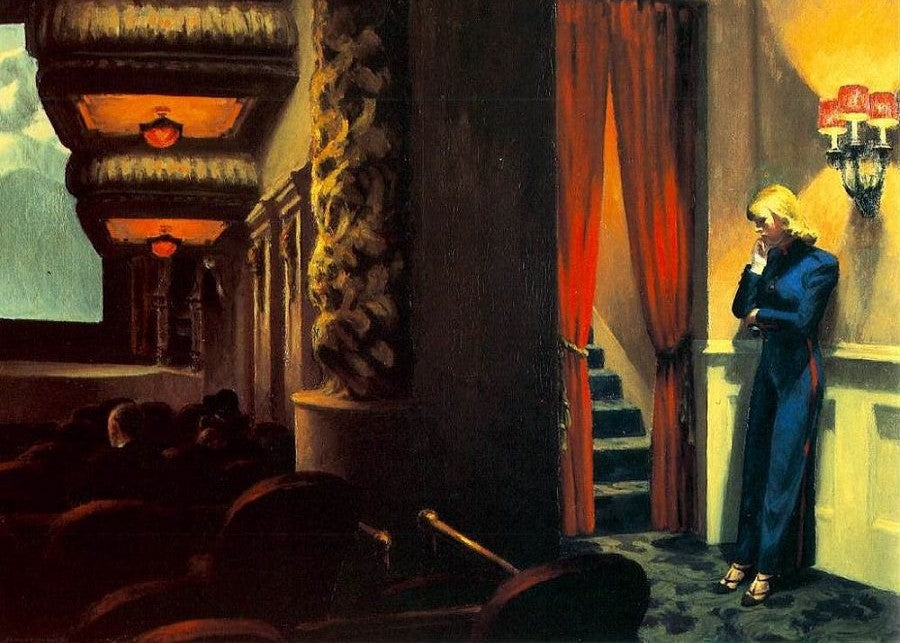
"New York Movie" (1939) by the late Edward Hopper
On a warm summer evening not so long ago, I joined a broad group of friends at Redleaf, a harbour beach tucked between Edgecliff and the mansion-flanked roads of Vaucluse.
‘Broad group’ is the only phrase for it: a mixture of my nearest and dearest, a handful of ‘sometimes-friends’, and a scattering of friendly acquaintances. It had been one of those near-perfect Sydney days. Blue sky and Goldilocks temperatures, with the promise of water still warm enough for a swim after sunset.
Redleaf is a regular haunt for my friends. In fact, reflecting now, the gathering may have begun as my idea, floated to a close friend who is one of those people blessed - or burdened - with too many friendships to properly maintain. As these things tend to do, the invitation expanded. By early evening, the (now much larger) group had descended on the grassy slope, beers ready to crack open and takeaway pizzas en route. We swam until our skin prickled with goosebumps, lying wet on the pontoons before returning to land and slipping hoodies over our bathers. The best word I can find for this ‘broad group’ is glittering. They are actors, artists, dancers, photographers, DJs, stylists; people with tasteful tattoos, strong opinions, and charisma to burn. They are also good, kind, warm people.
And yet, placed within the folds of a large group of friends, I become less a participant than a dilute solution of myself. The qualities I privately think of as constituting a personality - my humour, curiosity, conviction, warmth - seem to dissolve as the collective atmosphere thickens. In their place emerges a peculiar form of self-surveillance. Rather than participating in conversations, I find myself monitoring them, assessing each contribution as it leaves my mouth, wondering why I feel so utterly alien among people I call friends. I feel yanked and misaligned, like a venetian blind after someone has tugged at the wrong cord and left the whole thing crooked. I search for exits from conversations, while simultaneously dreading the prospect of entering another. I grow numb and bored - mostly of myself.
By mid-evening, I do what I almost always do. I smoke-bomb. No goodbyes. One minute I am there, the next I’m gone. As I slide beneath the covers, I often wonder whether this disappearance - both literal and metaphorical - is some innate failing on my part.
*
Whilst I have little in common with Emily Dickinson, I lack her talent, her formidable middle part and her reclusiveness. Yet she describes a feeling I know well: the desire for connection and then, once surrounded by a group of people, a peculiar sense of estrangement. Dickinson’s estrangement was undoubtedly more pronounced than mine. Still, the final stanzas of ‘I had been hungry all the Years’ capture something I recognise about the experience of socialising in groups:
The Plenty hurt me—
’twas so new—
Myself felt ill—and odd—
As Berry—of a Mountain Bush—
Transplanted—to a Road—
Nor was I hungry—so I found
That Hunger—was a way
Of Persons outside Windows—
The Entering—takes away—

And it’s not just evenings like the one at Redleaf that make me feel like “a berry of a mountain bush/transplanted to a road”, it’s group text chats (which I loathe), foyers after a show, extended family gatherings, big pub lunches, really anything that demands I find a version of myself that is widely palatable, or become adept at modulating from person to person. I’m good at neither.
*
A generous way of understanding this feeling is via a media theory called ‘context collapse’. I first came across the term in 2019 while reading Jenny Odell’s How to Do Nothing, one of the earliest books I remember reading that grappled with the ‘attention economy’ before these ideas had fully entered our everyday understanding of social media. Odell borrows the concept from media scholar Danah Boyd, who coined the term to describe one of social media’s disorienting effects. Context collapse occurs when audiences that would ordinarily remain separate are flattened into one. The different versions of ourselves that emerge naturally in different relationships are suddenly required to occupy the same space.
A little like this:
Imagine you’ve just returned from a holiday. When you call your mother, you tell one version of the story. Certain details are emphasised, others omitted. The language, tone and rhythm of the conversation are shaped by the particular context of your relationship. Then you call your friend Jerry. He gets a different version. The incident involving the coconuts and the hotel safe, which would have landed flatly with your mother, sends him into hysterics. Later, your grandmother hears another version still. Then, on Monday morning, you recount the trip to your colleagues over bad office coffee.
None of these versions are more authentic than the others. They are simply contextual. Most human relationships operate this way. We are constantly adjusting our language, references, humour and disclosures in response to who is standing in front of us. Social media, however, asks these audiences to converge. The stories intended for friends, parents, colleagues, acquaintances and strangers are all delivered to the same room at once.
As Odell writes, context collapse creates a “‘lowest common denominator’ philosophy of sharing” that limits people to expressions of themselves that feel safe for every conceivable audience.
*
I sometimes wonder whether what I find so difficult about large groups of friends is a version of this same context collapse. When enough people, each attached to a different version of me, are gathered in one place, I struggle to synthesise. The result is often a strange, flattened self: a version broad enough to be understood by everyone and specific
to no one. I’m sure this is not a universal experience. It is entirely possible that I am simply awkward.
[Curiously, the opposite scenario poses no problem at all. Put me in a room where I know no one particularly well and I become, not just functioning but rather charming! With no existing contexts to navigate, there is only one self available. A mono-me. Portable, uncomplicated, easy to distribute.]
There are, of course, blessed individuals whose ‘group self’ appears unanimously palatable. I know several. These people seem to expand rather than contract in company. Watching them navigate multiple friendships at once is a bit like watching Messi in possession of a football. Everyone else appears to be operating under the ordinary constraints of physics and cognition; they have somehow negotiated an exemption. (I, too, have been watching the World Cup.)
*
There is no one-size-fits-all model when it comes to friendship. Recently, in France, I spent a week with a woman who, on the third day of what I considered a lovely and steadily developing friendship, informed me that she “didn’t do friends.” I probed. After all, we had just spent three days in delightful one-on-one conversation. There was connection. Simpatico. Mutual respect. If that wasn’t friendship, what the heck was it?
It turned out that friendship itself wasn’t the problem. It was the upkeep. The administrative side of friendship: the texting, the returning of calls, the regular coffees, birthdays, catch-ups and check-ins. To me, this seemed less an indictment of friendship than a preference about its form. It did not suggest that she was incapable of friendship, even that she didn’t want it, only that she did not enjoy practising it in the way many people do.
This seems to illustrate a broader truth. We tend to speak about friendship as though it were a singular thing, when in reality it encompasses a bewildering range of preferences, expectations and tolerances. What feels energising, natural and deeply authentic to one person can feel burdensome, performative or quietly exhausting to another.
Perhaps it would be better if, when becoming friends with someone new, we simply asked: How do you like to do friendship? It seems like a useful question. As Dickinson knew, there can be a strange distance between wanting to ‘enter’ friendship, in all its myriad forms and stylings, and feeling at home once inside:
Of Persons outside Windows—
The Entering—takes away—
CLAUDIAPRISCILLA.SUBSTACK.COM

%20by%20the%20late%20Edward%20Hopper%0A%C2%A0%0AOn%20a%20warm%20su...)
Leave a comment
This site is protected by hCaptcha and the hCaptcha Privacy Policy and Terms of Service apply.